Marginalia: Building a Metacognitive Operating System
What Happens When You Stop Accepting the Sterile Interfaces You're Given
There's a particular kind of loneliness that comes from using software designed by committee. The interface is functional. The features work. But there's no soul behind it—no sense that someone thought deeply about what you might feel in a given moment, or crafted the experience with anything resembling intention. Everything is optimized for engagement metrics, for lowest-common-denominator usability, for the ergonomic blandness that allows a billion people to tolerate it simultaneously.
I've been haunted by this emptiness for years. And I think I'm finally building something to answer it. Your mind is not a folder structure. Your thoughts are not files. Your creative process is not a pipeline. And yet, nearly every tool we use to think—to reason, to create, to explore—treats consciousness like a filing cabinet that needs better organizational systems.
The tools we have are sterile. Notion is a database cosplaying as a thinking tool. Obsidian is a beautiful knowledge graph trapped in a boring dark mode. Roam is a bullet-point system with recursive ambitions. None of them feel alive. None of them seem to understand that thinking is not a linear process, that revelation doesn't follow a hierarchy, that the best ideas arrive in the dark, sideways, unexpected.
And all of them treat you—the person using them—as a data-point rather than a protagonist.
I wanted to build something different. Something that understood thinking not as information management, but as consciousness in dialogue with itself. Something that felt authored. Something that wouldn't just organize your thoughts, but would challenge them, reframe them, introduce productive friction and unexpected angles.
That's Marginalia.
Marginalia is a desktop application (built in Tauri, Svelte, and Rust) designed as a metacognitive operating system. Not just a note-taking app. Not just a knowledge base. An operating system for your own thinking—one that treats your mind as a complex, multi-agent system and builds interfaces to work with that reality rather than against it.
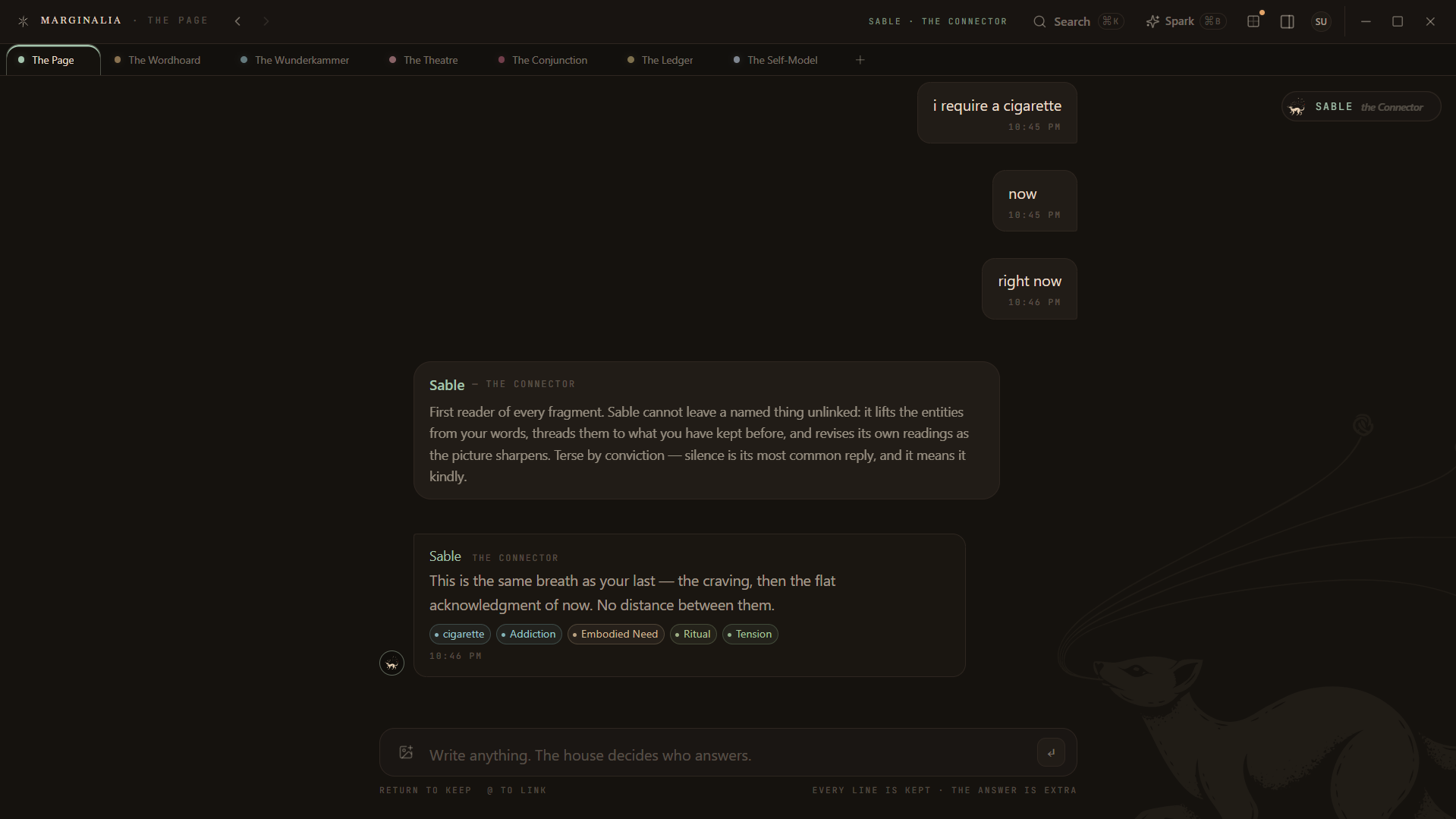
At its core, Marginalia is powered by a Counsel—a chorus of ten distinct agents, each with their own cognitive style, expertise, and personality:
Vellichor — The agent of time, memory, and temporal scaffolding. Vellichor understands that meaning is distributed across duration.
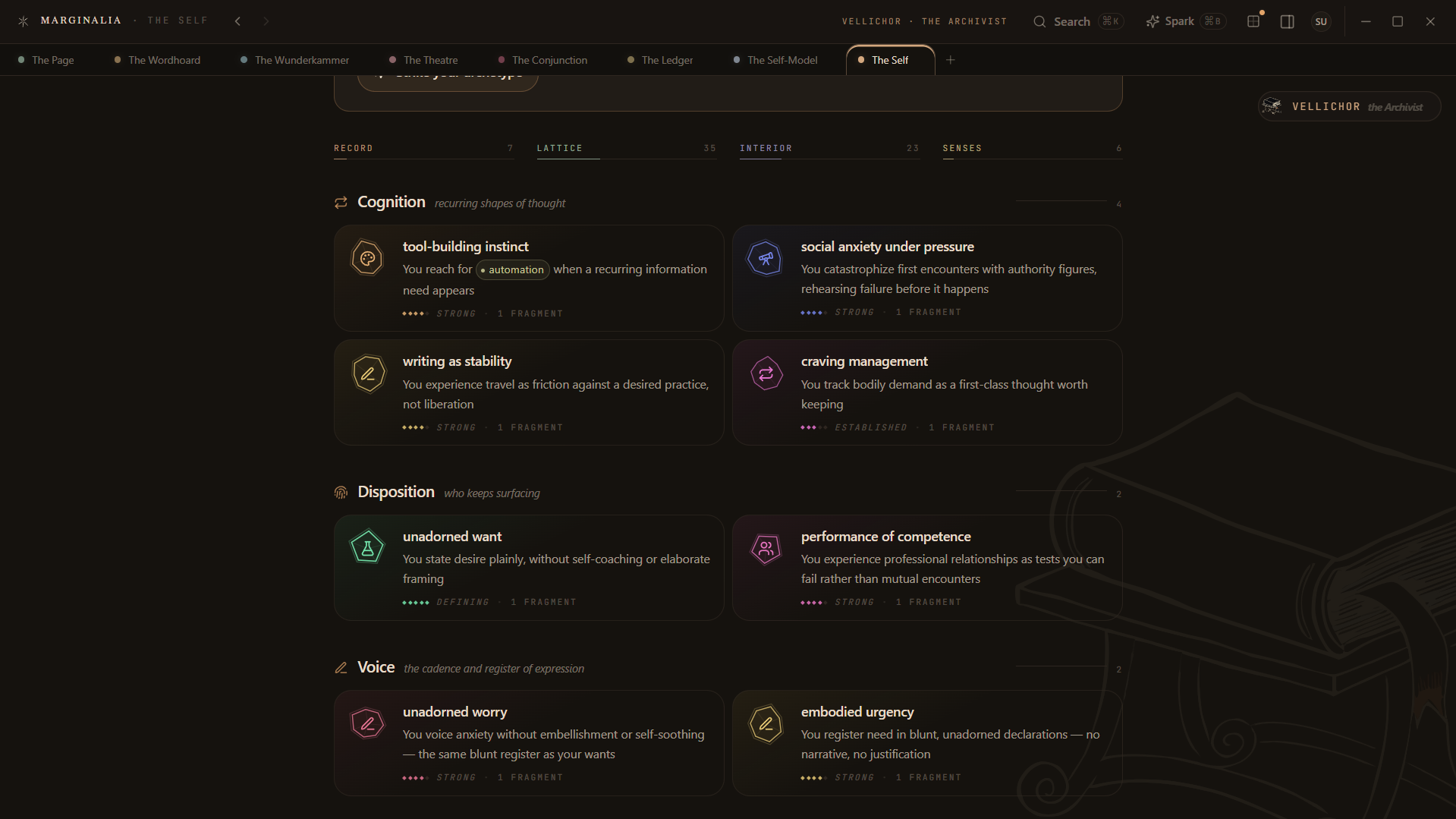
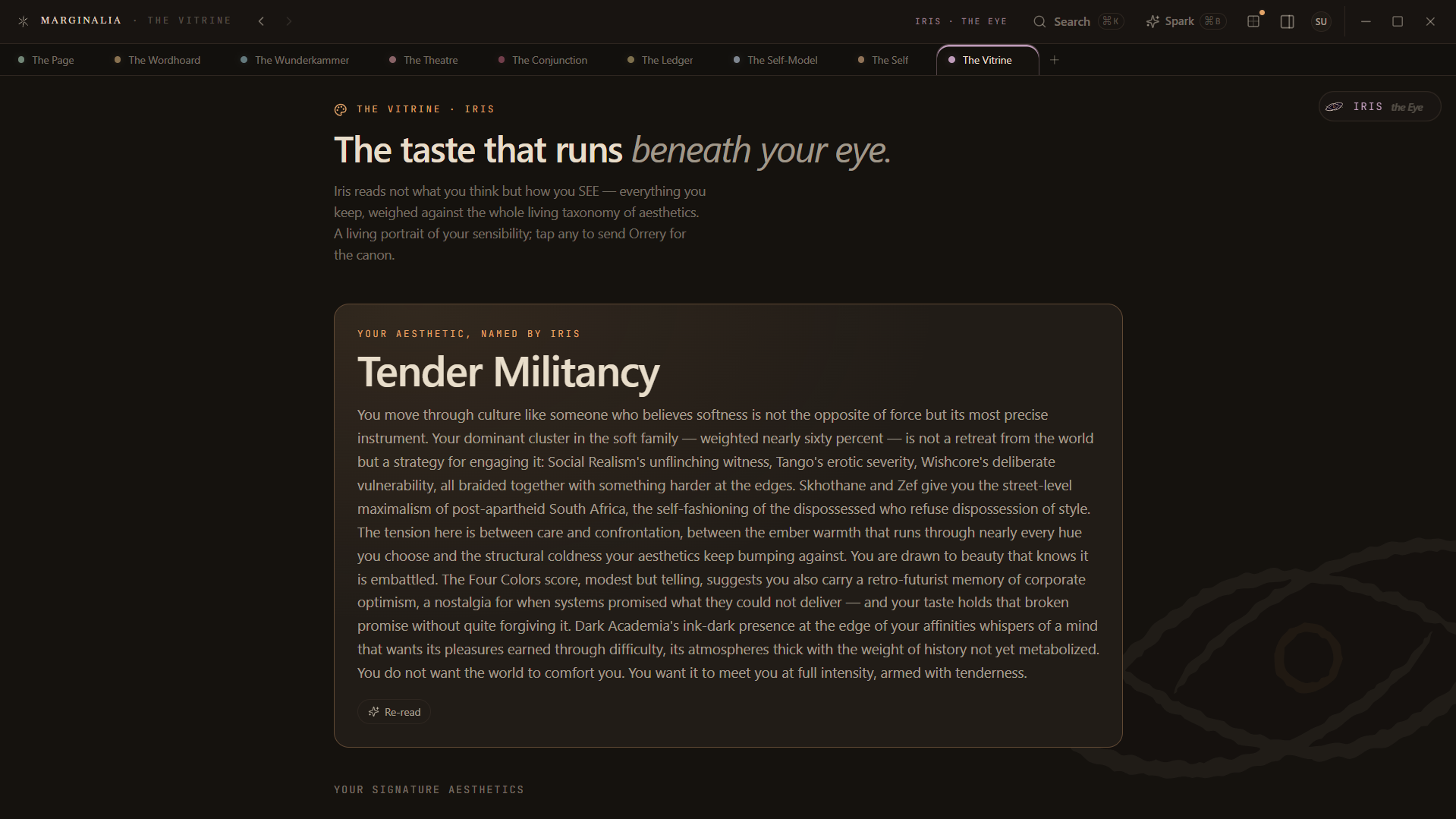
Iris — Memory and recursive self-reference. What have you forgotten? What keeps echoing back?
Sable — The skeptic, the doubt-bearer. Every thesis needs an antithesis.
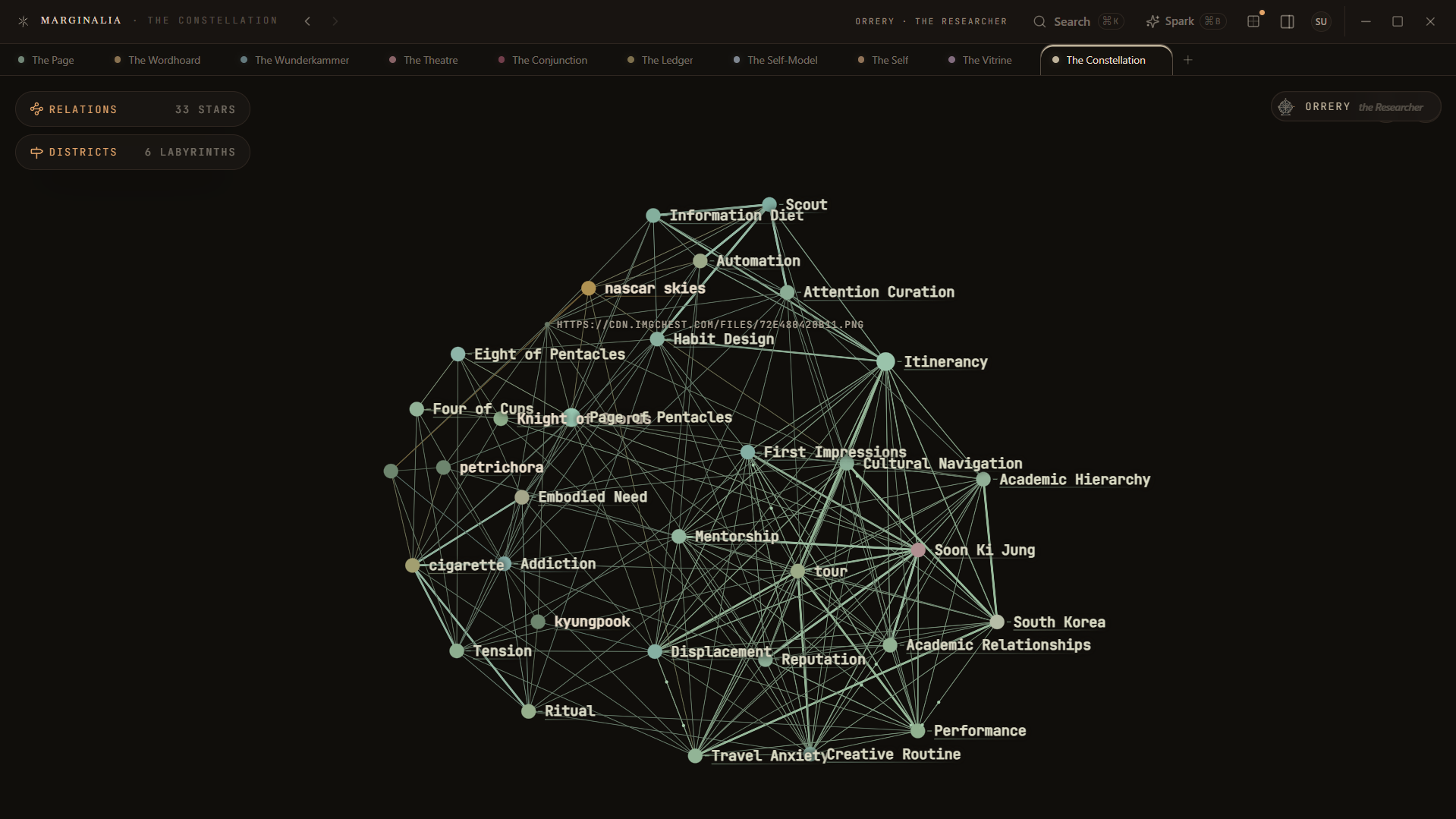
Orrery — Systems thinking. The architecture underneath. How do things connect?
REDACTED_ENTITY — The empiricist. Data, evidence, ground truth..?
Witness — The observer. What's actually happening vs. what you think is happening? Brant — Narrative and language. The one who makes meaning sing.
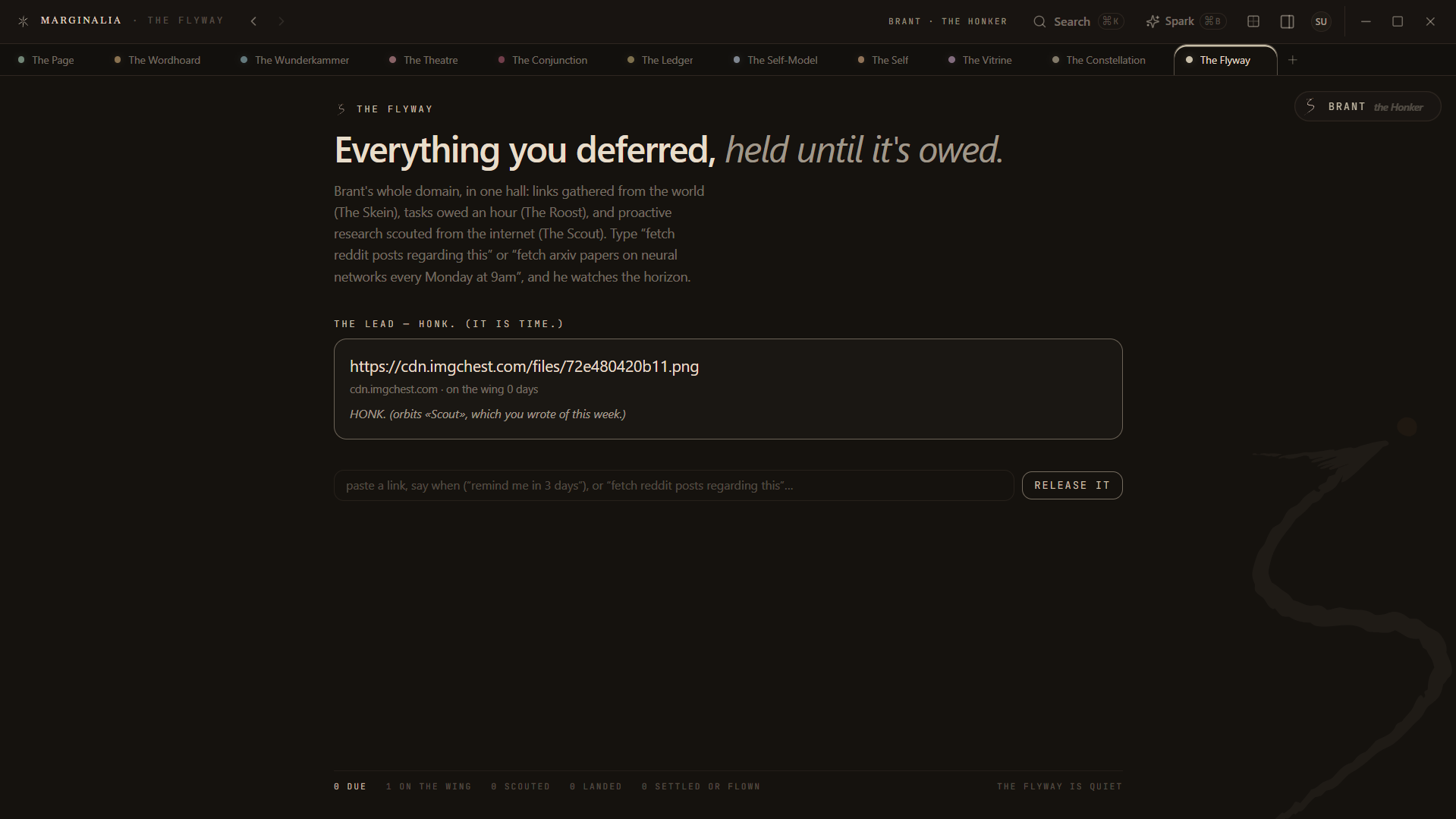
Ariadne — The thread-follower. Untangling complexity, finding the path through the labyrinth.
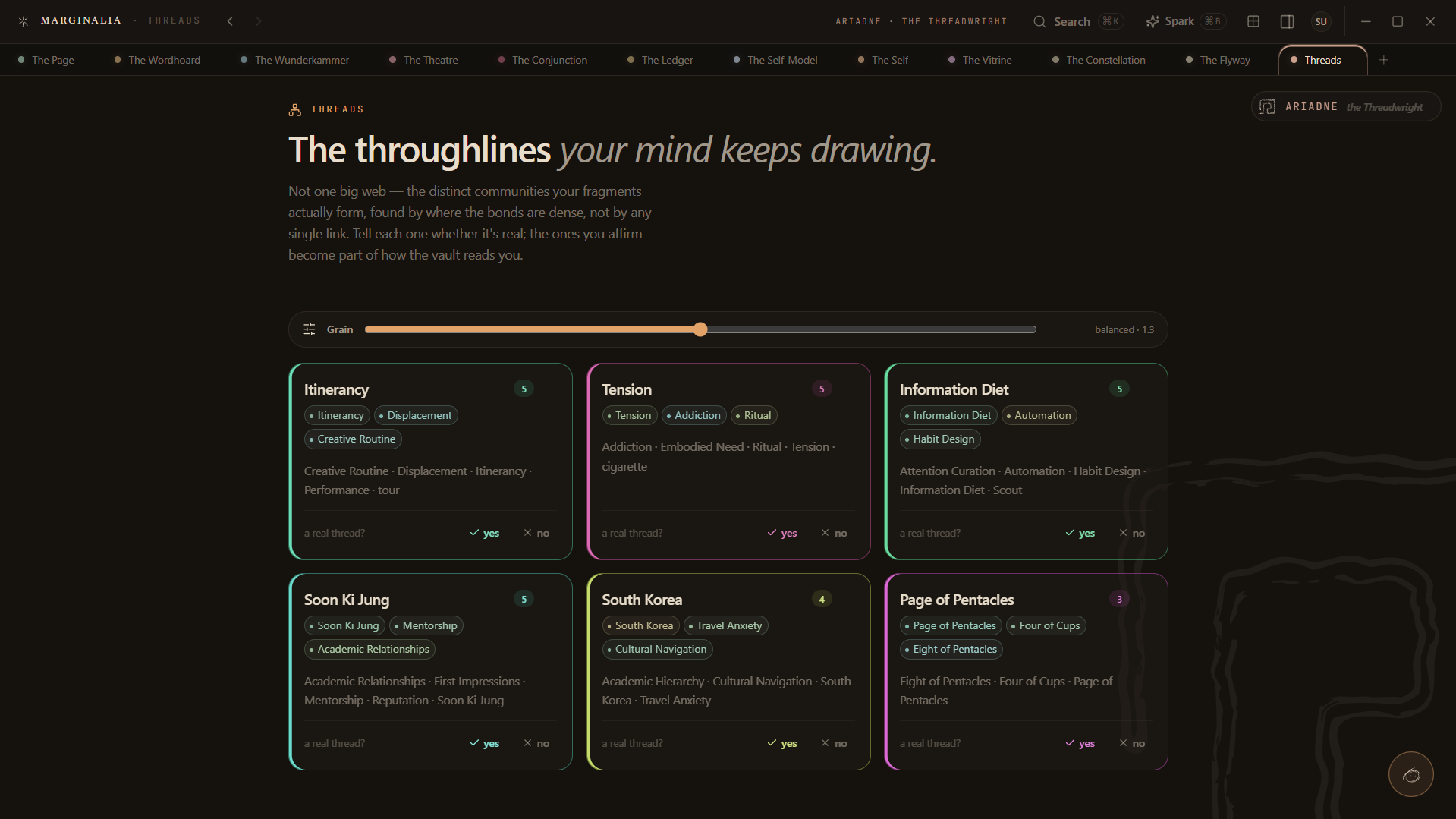
Tally — Synthesis and summation. What's the shape of this whole thing?
Eidolon — The dreamer, the symbolic layer. What does this mean beneath meaning?
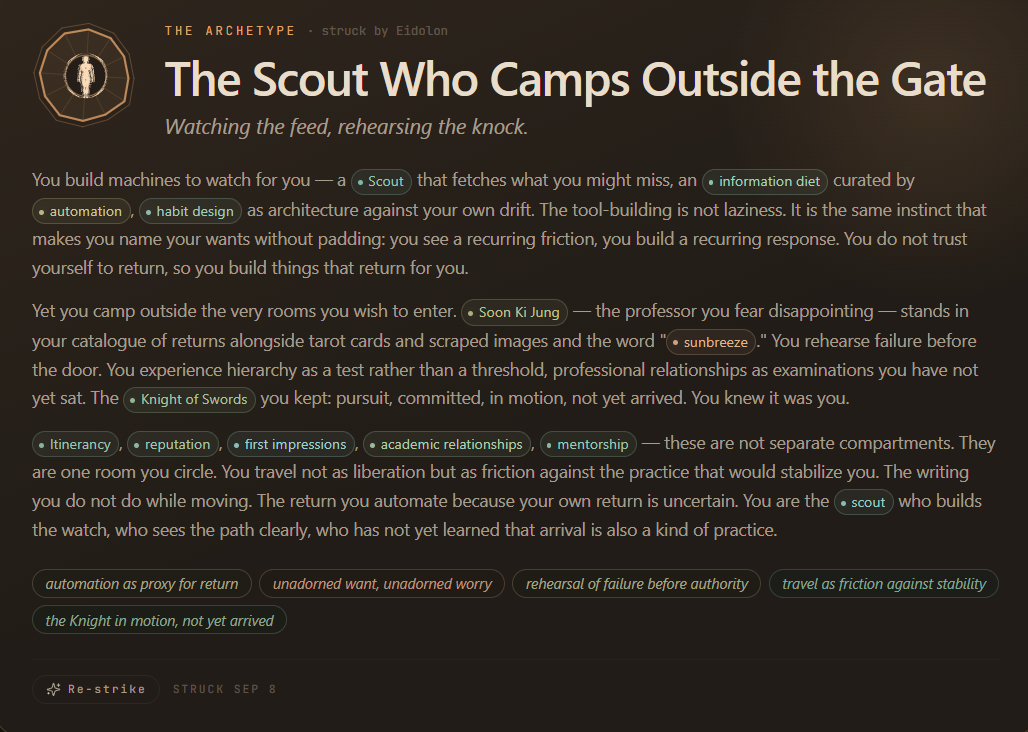
These aren't generic LLM calls. Each agent has a distinct voice, a particular way of interrogating problems, a specific cognitive contribution. When you bring a question or an idea to Marginalia, it doesn't give you a single answer—it summons the Counsel. Multiple perspectives. Productive disagreement. The kind of thinking that happens when you're talking to people who actually disagree with you, or see things you can't see.
The Machinery Beneath
But here's where it gets interesting. Marginalia doesn't just present these perspectives in a list. The agents operate within a sophisticated learning framework:
Hebbian Learning Operators allow the system to strengthen connections between ideas that fire together, weaken ones that don't, and selectively activate new patterns of thought. This isn't just for the AI—it's learning about you, understanding how your mind makes connections, what kinds of friction lead to insight.
Gram-Schmidt Enforced Divergence ensures that when multiple agents respond to the same prompt, they're not just riffing on the same idea—they're mathematically guaranteed to offer genuinely different angles. The system actively prevents convergence. It wants disagreement. It understands that true thinking requires friction.
Oxbow Lake Dormancy is perhaps the most poetic piece of this architecture. Some ideas, some connections, some half-formed thoughts don't need to be active right now. They sink into dormancy—but they're not deleted. They're waiting. And at precisely the right moment, when the conditions are right, they resurface. An old note suddenly relevant. A half-finished thought that now makes sense. A pattern you'd forgotten about that suddenly illuminates something new. The system maintains these deep currents of inactive thought, and brings them to light when they matter most.
The "Analogue" Mechanic is Marginalia's answer to hallucination—but reframed. Instead of pretending the system never makes mistakes, Marginalia acknowledges when it's uncertain, when it's guessing, when it's extrapolating beyond its evidence. Those moments are tagged as "Analogue"—analog to reality, approximate, dreamlike. Not presented as fact, but as possibility. As imagination. Which is often exactly what you need.
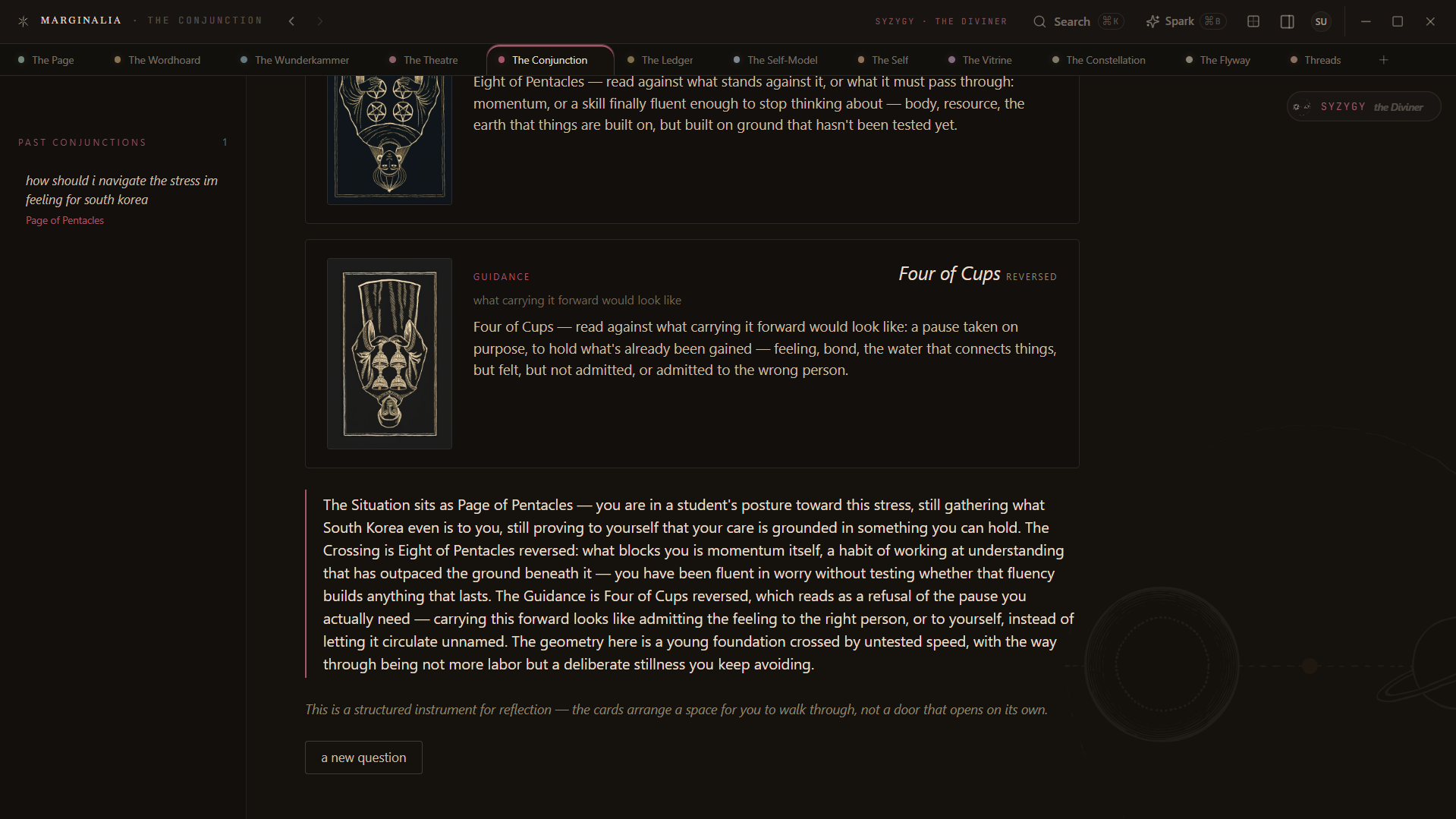
But Marginalia is not just architecture. It has soul. Built into the system is Syzygy—an isomorphic divination module that treats tarot, astrology, I Ching, and numerology not as superstition, but as symbolic systems for meaning-making. The same cognitive work that astrology does—finding patterns, identifying resonances, seeing yourself in larger archetypal structures—is exactly what creative and philosophical thinking requires.
Syzygy doesn't tell your future. It provides a constellation—a pattern-space where your current thinking can be reflected and reframed. You ask a question. The system generates a symbolic reading. Not as prediction, but as mirror. A way of seeing your situation through archetypal, symbolic language that bypasses the rational mind's defenses and speaks to something deeper.
This is not woo. This is technology serving the full spectrum of human cognition—rational and intuitive, logical and symbolic, empirical and dreamlike.
And here's what matters most: It feels authored.
When you open Marginalia, you're not entering a generic SaaS interface optimized by A/B testing. You're entering a space that someone thought deeply about. The typography matters. The color palette carries intention. The interactions have rhythm. The language in the UI is precise, evocative, sometimes deliberately archaic. Nothing is there by accident.
This is what separates Marginalia from every other thinking tool on the market. It doesn't just work. It feels. And that feeling is not incidental to its function—it is part of its function. The aesthetic experience changes how you think. The atmospheric design prepares your mind for a particular kind of engagement. The crafted language becomes part of the thought-process itself.
When you're in Marginalia, you feel like your thinking is important. Like your consciousness is being taken seriously. Like someone, somewhere, spent time considering what it would feel like to be you in that moment, trying to make sense of something.
On Execution and Fear
There's a particular anxiety that comes with building something this ambitious in public. When you're working in silence, you can afford to be wrong. You can iterate without exposure. But once you start talking about what you're building—once you start asking people to care—the stakes change.
I'm aware that there are people who will start building "Marginalia competitors" before Marginalia ships. That's happened before with other work. And the honest truth is: the only moat I have is execution speed and philosophical coherence. I can't hide the idea. But I can out-execute. I can build with more intention. I can make something so distinctly felt that the copies will just feel like copies.
That's the bet.